
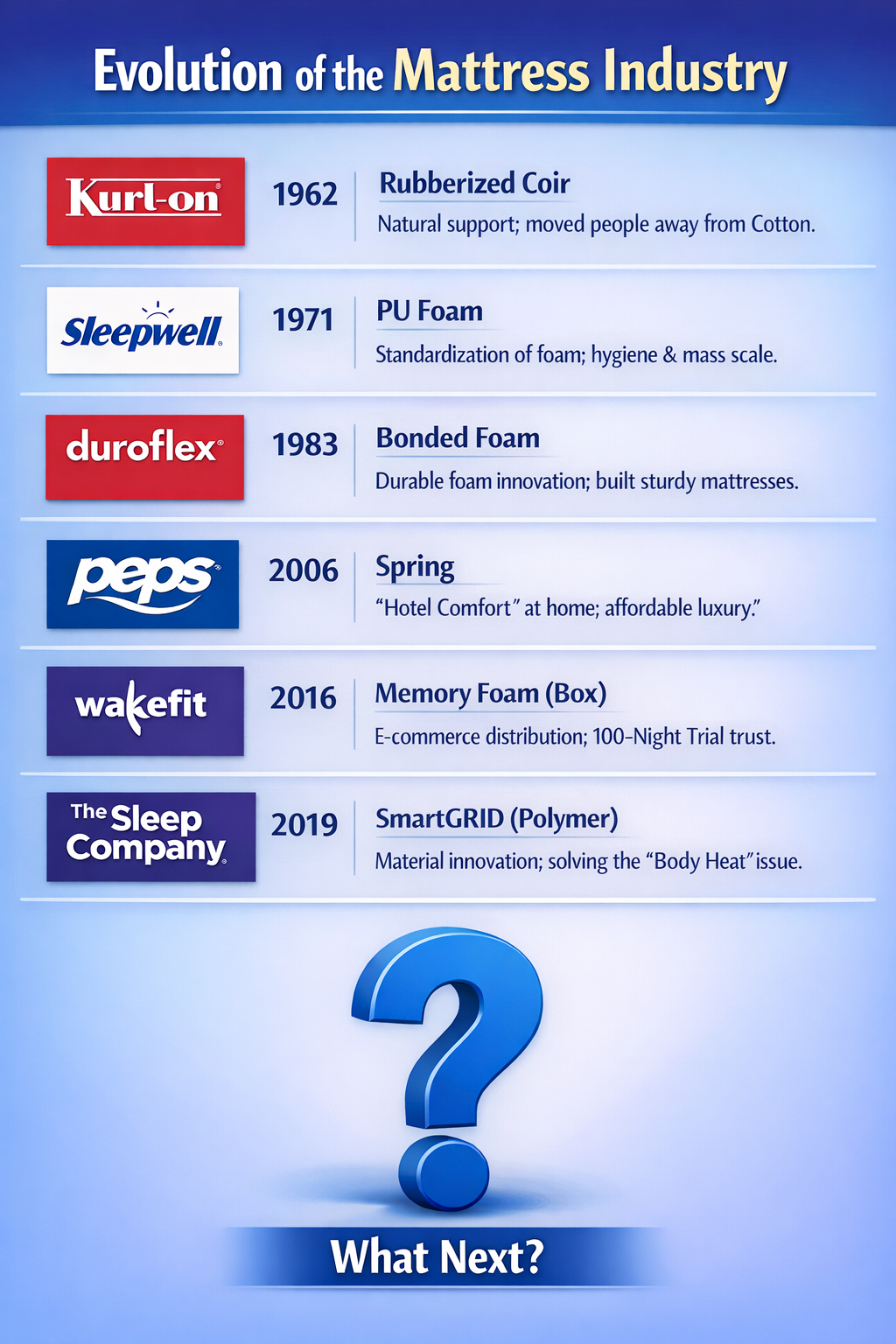
From Cotton to SmartGRID: The 6 Milestones That Changed How India Sleeps
If you grew up in an Indian household before the 90s, your definition of a 'mattress' was likely very simple: a lumpy, heavy, cotton-stuffed Gadda. It was a functional necessity, often requiring a local artisan to beat and fluff it back to life every few years. Comfort was a luxury; support was nonexistent.
Fast forward to today, and the scenario has flipped entirely. The Indian mattress industry has evolved from an unorganized commodity market into a tech-driven powerhouse worth billions. We have moved from simple padding to complex engineered foams, and from buying at dusty local bazaars to unboxing vacuum-sealed beds delivered to our doorsteps.
But this transformation didn't happen overnight. It was driven by specific disruptors—brands that dared to introduce new materials, unheard-of technologies, and entirely new ways of selling. Here is a deep dive into the six major milestones and the brands behind them that forever changed the way India sleeps.
1. Kurl-on: The "Natural" Upgrade
Estimated Peak Turnover: ~₹950 Crore
Before Kurl-on, the market was almost entirely dominated by cotton. Kurl-on pioneered the Rubberized Coir mattress. This was a massive milestone because it used a material Indians were familiar with—coconut fiber—but processed it with latex to create something durable and supportive. For decades, Kurl-on owned the concept of "back support" in India, bridging the gap between traditional materials and modern sleep needs. They convinced a generation that a mattress should be firm and structured, not just a sack of soft cotton.
2. Sleepwell (Sheela Foam): The Foam Revolution
Estimated Peak Turnover: ~₹3,000+ Crore (Consolidated)
While coir was supportive, it was heavy and rigid. Sleepwell championed the Polyurethane (PU) Foam revolution. They introduced the Indian mass market to the "luxury of softness" and hygiene, which was previously seen only in expensive hotels. Their major contribution was standardizing comfort; unlike local, cheap foam that crumbled, Sleepwell offered standardized densities and long life. They also transformed retail by setting up a massive network of exclusive showrooms, making the mattress a "display product" rather than a back-room commodity.
3. Peps India: Affordable Luxury (Spring)
Estimated Peak Turnover: ~₹560+ Crore
For a long time, spring mattresses were viewed as overly expensive imported luxuries that were "bad for the back." Peps entered the market to debunk this myth. By partnering with Restonic (USA) and manufacturing domestically, they democratized the Spring Mattress. They targeted the "new age" Indian buyer who traveled abroad and wanted that bouncy "hotel bed feel" at home. Peps successfully carved out the "affordable luxury" segment, moving a significant chunk of the middle class away from standard foam and coir.
4. Duroflex: The Legacy Giant Reborn
Estimated Peak Turnover: ~₹1,000+ Crore
Duroflex is a unique milestone because it represents the successful reinvention of a legacy player. Founded in the same era as Kurl-on, Duroflex spent decades as a traditional coir/foam manufacturer. However, around 2018, facing intense competition from startups, they aggressively pivoted. They rebranded as a total "Sleep Solutions" company, launched their own "bed-in-a-box" (LiveIn series), and adopted modern digital marketing. Duroflex proved that an old-world manufacturing giant could successfully adapt to the new-age D2C playbook, bridging the trust of the older generation with the convenience demanded by the new.
5. Wakefit: The D2C & "Mattress in a Box" Disruptor
Estimated Peak Turnover: ~₹1,200+ Crore
Wakefit didn't just launch a product; they changed how India buys mattresses. They identified that mattress prices were inflated by dealer commissions and logistics were a nightmare. They adopted the "Mattress in a Box" concept—vacuum compressing memory foam beds to ship easily via e-commerce. Perhaps their biggest contribution was pioneering the 100-Night Free Trial, which single-handedly built the trust required for Indians to buy a high-touch product online without seeing it first.
6. The Sleep Company: Material Science Innovation
Estimated Peak Turnover: ~₹500 Crore (Run Rate)
By 2019, the online market was flooded with similar memory foam competitors. The Sleep Company disrupted the disruptors by rejecting foam as the primary support layer. They introduced SmartGRID technology, a hyper-elastic polymer grid developed by ex-DRDO scientists. This was a true material science innovation aimed at solving the biggest complaint about memory foam: body heat retention. They effectively created a "luxury tech" segment, proving the market was ready for patented innovation over generic materials.
Conclusion
As these sleep giants evolve into full-home wellness brands—launching sofas, recliners, and smart furniture—they aren't just selling a bed; they are poised to conquer the entire living space of an untapped, aspirational India.